


EXCLUSIVE: Four Titanique off-Broadway investors initiated an arbitration against the lead producer of the “splash hit musical,” which has said it was defrauded by its former general manager and reported losing $3 million in its final 18 months.
The backers’ dispute with producer Eva Price and the production entity Iceberg Ahead LLC concerns their “investment in the Company, the… oversight of the Company and the internal affairs of the Company,” according to a filing in New York Supreme Court. The investors filed the demand for arbitration in spring 2026, about nine months after the show closed at the Daryl Roth Theatre in Union Square and shortly before it reopened on Broadway at the St. James Theatre. The Broadway production closes on Sunday.
It’s rare for investors to take legal action against theatrical producers, despite ever-costlier flops and varying degrees of financial transparency. An exception is the suit over the failed 2024 Broadway revival of Cabaret. The lead producer, ATG Entertainment, has denied any wrongdoing and is seeking to dismiss the case.
I don’t know the specific allegations of the Titanique case. Much of the court filing in which it came to light is sealed from public view.
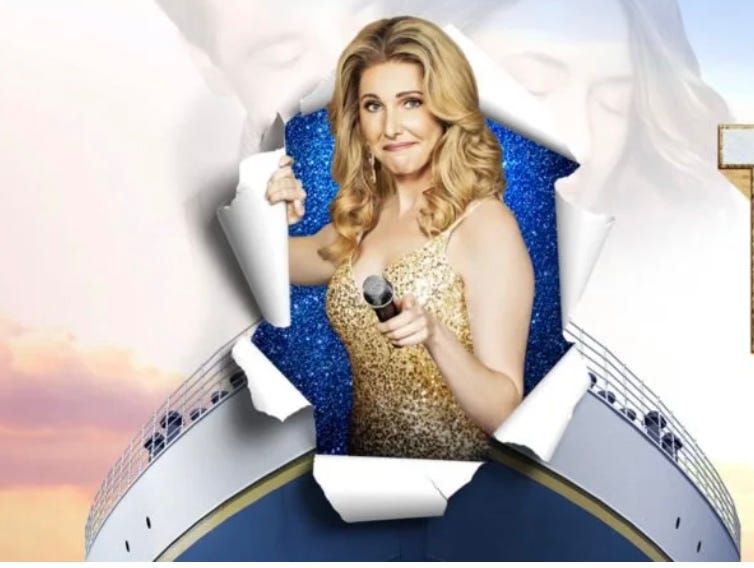
A satire of the James Cameron movie Titanic, featuring an over-the-top Celine Dion character, Titanique began performances in New York in June 2022 at the Asylum NYC comedy club in Chelsea. By 2024, it had repaid backers 60% of the roughly $1 million capitalization. In the second half of its three-year run, the campy comedy came apart.
In early 2025, it fired its general manager, Carl Flanigan, after he confessed to secretly diverting funds and falsifying documents, the production said in a May 2026 email to Broadway Journal. Flanigan worked for Maximum Entertainment Productions, which was co-founded by Price and was both Titanique's lead producer and general manager.
Flanigan had signed a deal with a Virginia financial company, Kapitus Servicing Inc., to borrow $195,000 against $278,000 of Titanique’s future off-Broadway earnings, according to a loan document filed in court. He transferred the loan proceeds to “unrelated third parties” and doctored bank statements, the production said in court papers in Virginia.
Flanigan was also accused by Iceberg Ahead — aka the production — of arranging other unauthorized loans, including between Titanique and other shows led by Maximum. The production later secured a $4.3 million civil judgment against him, by default. Flanigan didn’t respond to the production’s suit against him, or to my emails and texts.
The court filings aren’t explicit about whether Titanique off-Broadway was lending money to or borrowing money from other shows. A statement that the production provided to Broadway Journal suggests that Titanique may have been a beneficiary.
“Carl Flanigan’s financial misconduct meant that all [Titanique] off-Broadway investors were unjustly enriched during the run, recouping more of their investment than an accurate accounting would have entitled them to,” a production spokeswoman said in an email. “The investors holding the vast majority of ownership interest in the off-Broadway production understood this reality and are satisfied with how the matter was handled.”
The spokeswoman said the four Titanique investors are pursuing the case “with baseless claims apparently intended to harass the producer.”
Matthew Schenker of Fox Rothschild, who represents the investors, didn’t return emails and calls. The investors — Philip Byron, Marcia Ellis, Seth Gottesdiener and Christopher Zelno — declined to comment or didn’t return emails or were unreachable. None have Broadway co-producing credits, according to the Internet Broadway Database.
Putting aside the alleged unauthorized loans between productions, it’s unclear why Flanigan arranged to borrow $195,000 against Titanique earnings — especially when there weren’t any. Titanique lost money in 74 out of its final 78 weeks — a total of $3 million lost in 2024 and 2025, according to financial statements filed with the office of New York Attorney General Letitia James. Those financial statements were filed after Flanigan left the company.
The financials filed with the state were compiled by the accounting firm Withum, based on figures supplied by the production. Titanique off-Broadway wasn’t audited — a more rigorous and expensive process in which an accountant vouches for the numbers.
The statement from the production noted that non-audited “compiled financial reports are standard and customary” for off-Broadway. Still, beyond firing Flanigan and winning a civil judgment against him by default, Titanique referred the matter to the U.S. Attorney's Office for the Southern District of New York, the production said. This week, a spokesman for the U.S. Attorney’s Office declined to comment.
The production spokeswoman said that Maximum has commissioned a detailed forensic accounting of Titanique’s off-Broadway finances.
The dispute became public when the investors moved to disqualify a lawyer from representing Iceberg Ahead — which the backers co-own — who also represented Maximum Entertainment and Price herself. Below is the statement to Broadway Journal from the production spokeswoman — who said she was writing on behalf of Price:
We’ve already acknowledged that the former General Manager, Carl Flanigan, engaged in financial misconduct and misrepresented the financials of the company to the Producer, other staff members, and to the Investors.
On the audit question: compiled financial reports are standard and customary for this type of entity. Going beyond that, Maximum commissioned a detailed forensic accounting of the company’s finances.
As we’ve previously explained, Carl Flanigan’s financial misconduct meant that all off-Broadway investors were unjustly enriched during the run, recouping more of their investment than an accurate accounting would have entitled them to. The investors holding the vast majority of ownership interest in the off - Broadway production understood this reality and are satisfied with how the matter was handled.
We don’t have further comment on the decision by these four investors, out of the majority who invested, to continue pursuing this matter with baseless claims apparently intended to harass the producer.
IN MEMORIAM: Very sad about Spring Awakening composer Duncan Sheik’s death, at 56. A lovely man who leaves behind a remarkable catalog of songs.