


EXCLUSIVE: Operation Mincemeat is “the most rewarding theatrical experience I’ve ever had,” the reporter and novelist Taffy Brodesser-Akner wrote earlier this year in The New York Times Magazine.
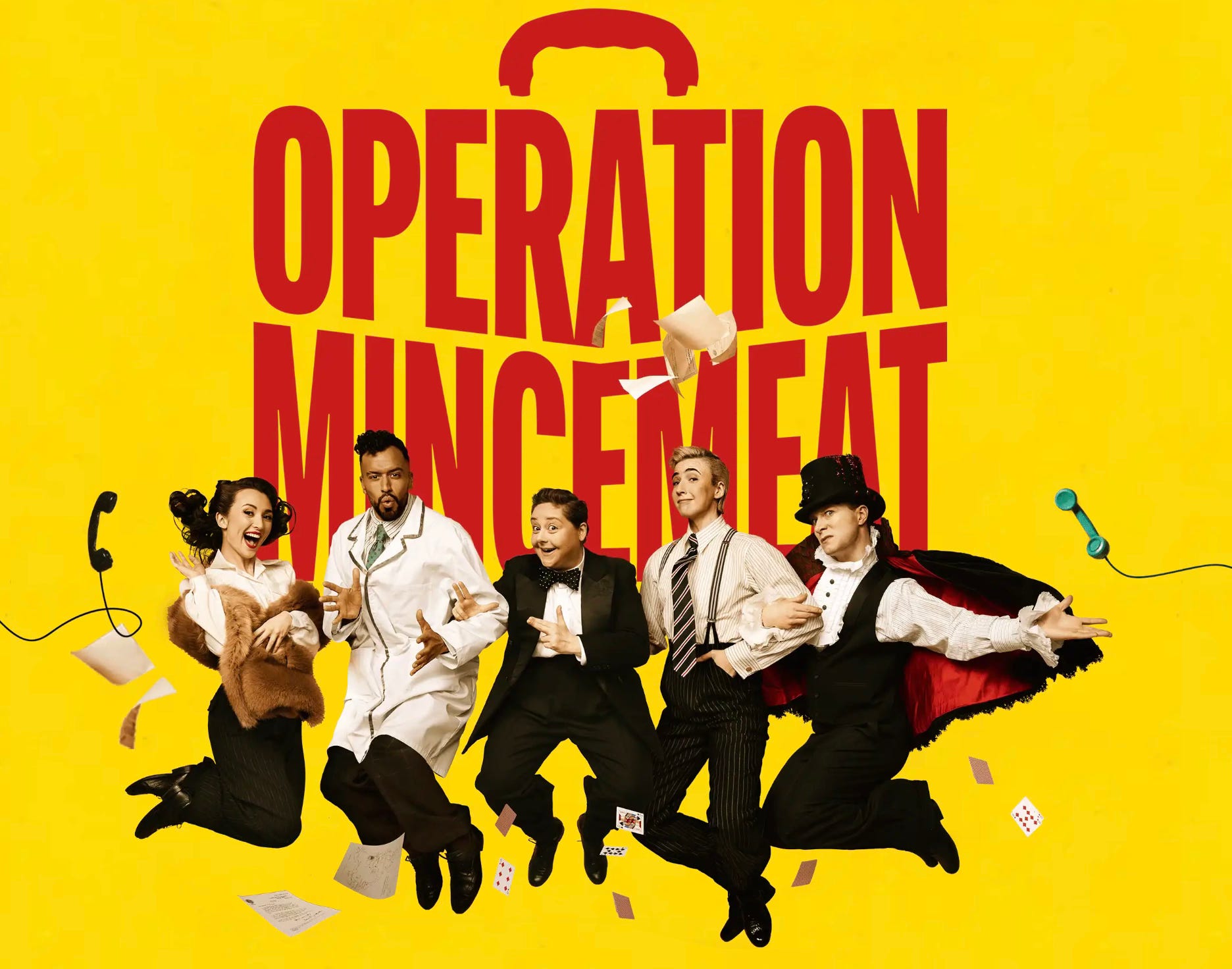
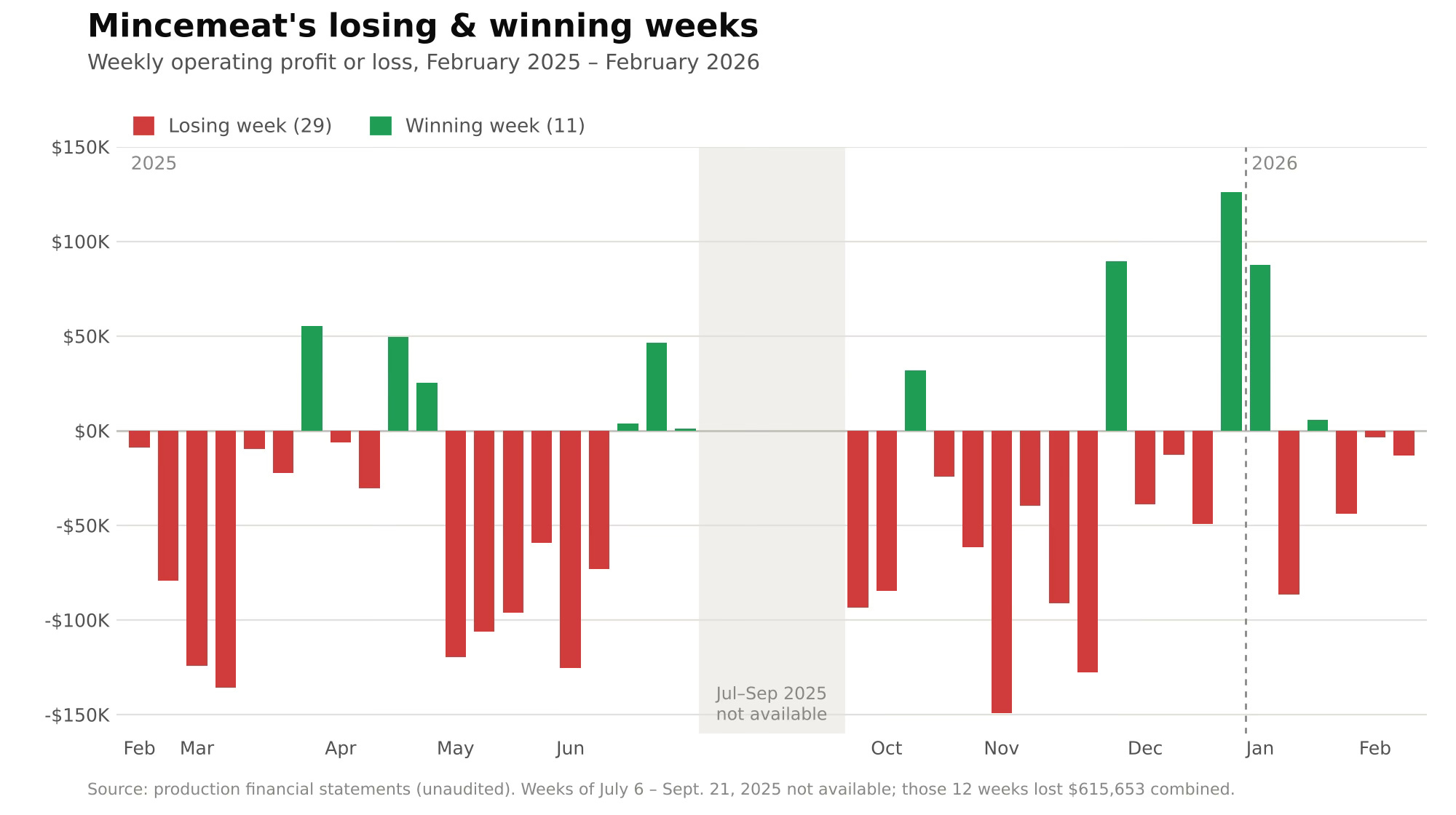
The musical’s proved less rewarding for its investors. Nearly two years into its run at the Golden Theatre, backers haven’t been repaid any of the show’s $12 million capitalization. The comedy, about an audacious World War II military mission, lost $2 million from weekly operations in its first year, according to an unaudited production financial statement. There were additional losses this summer, Mincemeat’s lead producer, Jon Thoday — a U.K. television executive and talent manager — told Broadway Journal.
In a recent Zoom meeting, investors and co-producers questioned why the Broadway production, which has grossed more than $65 million to date, didn’t make a distribution after receiving a $3 million New York State tax credit. (The subsidy program dates back to the pandemic.) Thoday was also asked why he hadn’t deferred any of his weekly income, as producers of struggling shows often do to facilitate repayment to investors.
“I find that obnoxious,” Thoday said, according to someone who heard his response. The producer later told Broadway Journal: “The idea that I ask the royalty holders or people who are working hard — or, frankly, me and anybody who works with me — to waive their royalties is not something I want to consider.”
He said he’s hopeful that Mincemeat runs for years, and he wants to make a distribution as soon as possible. “But I’m not going to do that to the detriment of the show.”
It’s a tough time for Broadway investors: of the 18 commercial musicals that opened in 2024-25, only Just in Time, originally starring Jonathan Groff, recouped its costs (although others returned some money to backers). Mincemeat was well-positioned to beat the odds. In London, it won two Olivier Awards and eventually earned a small profit. Its capitalization and roughly $700,000 in weekly expenses are low for a Broadway musical. In investment papers, the show projected that it could recoup its production costs in less than a year by grossing just 75% of its box office potential.
But the critics’ darling in London had a high-profile holdout in New York. The Times’ chief theater reviewer at the time, Jesse Green, called it “diverting if irksome,” albeit with flashes of seriousness and beauty. (In its advertising, the production quotes Brodesser-Akner from her 5,300-word story, “Why on Earth Have I Seen the Same Broadway Show 13 Times?”) And heavy marketing undercut its cost advantage, contributing to an average weekly loss of $39,000.
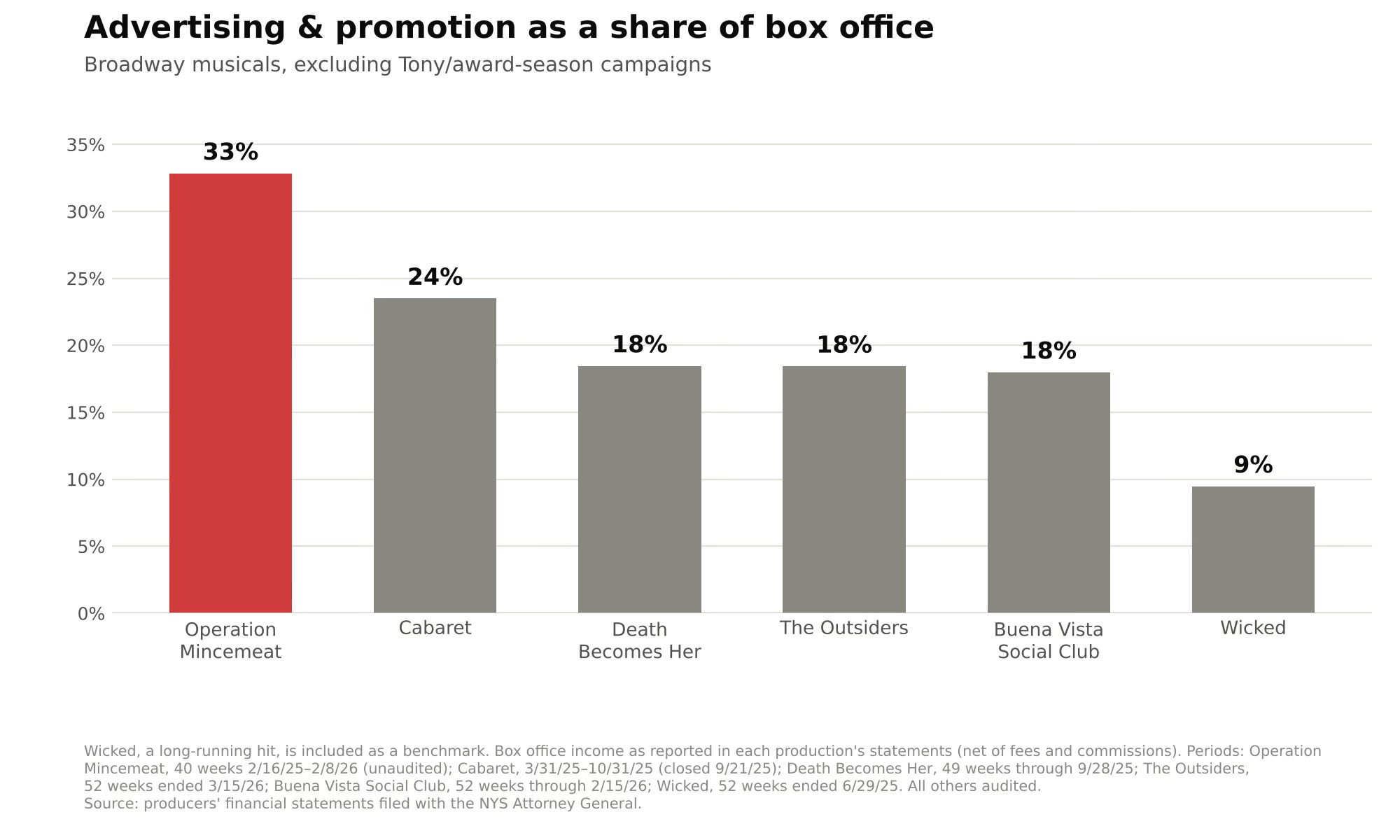
The show spent $195,000 to $235,000 a week on ads and promotion in its first year, not counting its Tony Awards campaign. The ad spending was substantially above the $160,000-a-week forecast in a preliminary operating budget. It was a third of its box office income, compared with 18% at the rival musicals Death Becomes Her, The Outsiders and Buena Vista Social Club, according to their financial statements.
Thoday maintains that traditional ad spending is inadequate for a new Broadway brand, and the size of the show doesn’t dictate the amount of marketing. “It doesn’t cost less to launch a drink than it does to launch a motor car, or to launch a giant feature film,” he told me.
“If you see growth, pile in,” he said. “We’re not seeing decline, and we are piling in.”
The producer was somewhat contradictory about advertising. In an email, he called Mincemeat’s ad spending “modest compared with that of a big musical.” But in our interview, he said the show “does cost similar amounts of money to a bigger musical to market” — which is what the financial statements indicate.
The Broadway backers I heard from questioned whether the advertising was driven by necessity or ego, and contended that Thoday is building the Mincemeat brand at their expense. (He didn’t respond to an emailed question about that.) They noted a disconnect between their losses and the production’s 12 extensions. “Every other show I have been involved in since the start of the tax credit has used it to pay outstanding bills and then distributed the rest of the money to the investors,” one backer said. “Investors and co-producers are really angry!”
Thoday’s compensation is generous for a musical without profits. As of February, the company he co-founded, Avalon, was paid $12,690 a week on Broadway, including a producer’s fee, producer and “originating producer” royalties, office charges and expenses. (The figure is from the first year of the run.)
A veteran general manager who reviewed the documents was struck by the weekly $3,000 producer’s fee, given that the show’s also paying an executive producer to oversee it. Of a dozen other recent Broadway musicals I studied, just one — ATG Entertainment’s 2024 revival of Cabaret — paid weekly fees to both a lead producer and executive producer, and those fees were waived in its final months. Thoday didn’t answer detailed questions about pay, but suggested that it wasn’t all his. Asked how much of the $12,690 weekly producer compensation goes to him, he said, “I honestly don’t know the answer to that. I run a company.”
Thoday said Avalon made a $600,000 priority loan to the production, which the show repaid after receiving the tax credit. He insisted that most Mincemeat investors are supportive of his strategy, especially those involved since London, but declined to identify any of them. He noted that an Australian tour scheduled for October 2027 will join productions in London and New York and tours in North America and the U.K./Ireland. “Mincemeat is a small show that is becoming a big show,” he wrote in an email.
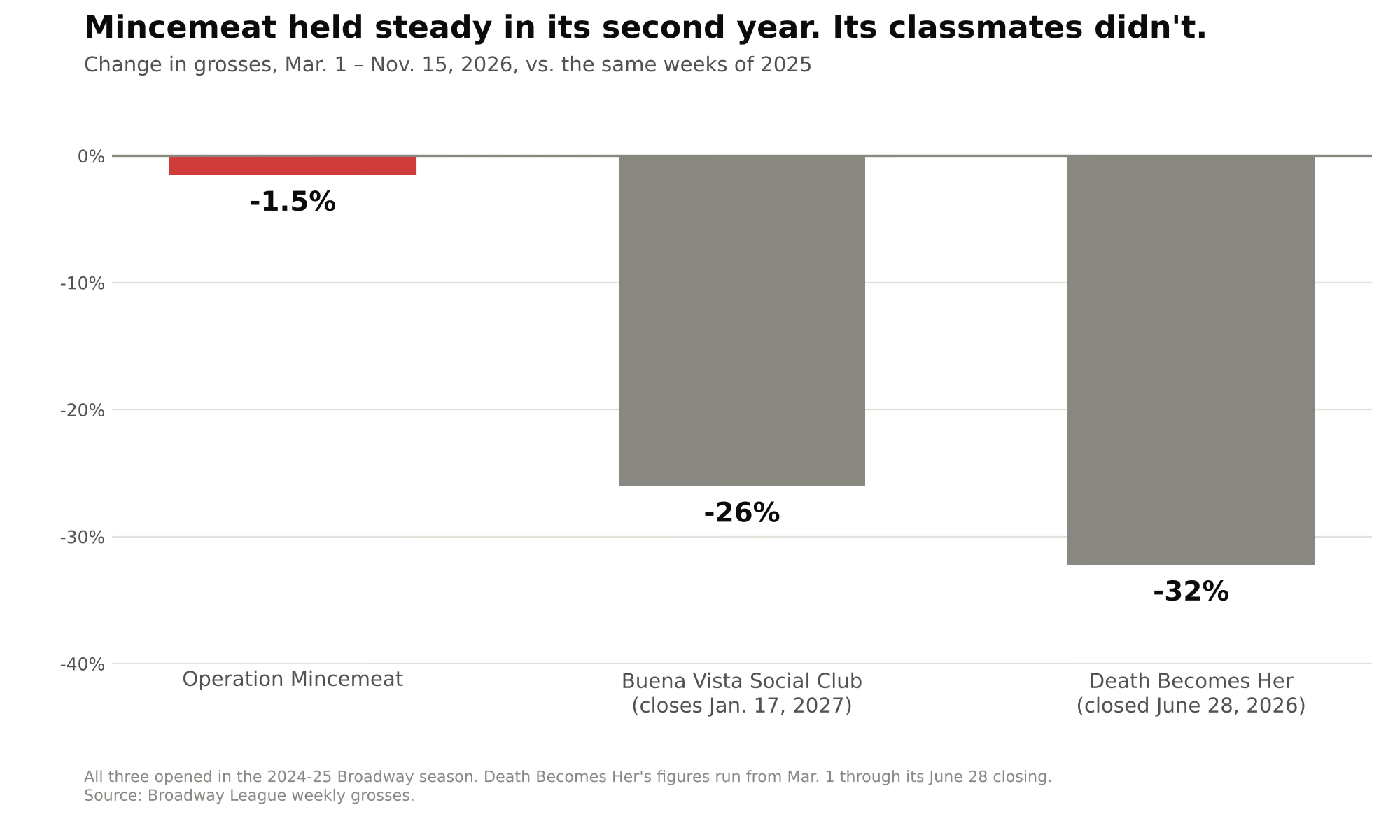
Mincemeat’s Broadway grosses have held up in its second year and even risen this fall — an accomplishment for an original musical cast mostly with little-known actors. In October, box office sales were 11% higher than in October 2025, according to Broadway League data. The advance sale is up 30% to $3.5 million, Thoday said, adding that after a cut in advertising this year, “it has a good chance of becoming long-term profitable on Broadway as it has done in London.”
The London production, which opened 3 1/2 years ago, “made north of 10%” profit, Thoday said in an email. That suggests a total investor return of only about 6%, given the standard 60/40 profit split with producers in the West End. He said he’s trying to move Mincemeat from the Fortune Theatre, which has about 430 seats, to a larger venue.
On Broadway, turnarounds 21 months into a run are rare. Mincemeat is already competing for attention against Paddington — a smash in London that opens at the Al Hirschfeld Theatre in April — and other new musicals this season. And celebrity casting, which helped propel the Chicago revival’s 30-year marathon, doesn’t lend itself to a closely calibrated ensemble of five actors playing 87 characters. (The original cast — which included three of the show’s four authors and Jak Malone, who won a Tony for featured actor in a musical — left in February.)
Thoday said he will decide later this month whether to make a first distribution to investors, adding that the production needs “to maintain good cash balances.” Next year, it should be clearer whether he’s an innovative iconoclast rewriting the rules of Broadway — or a producer making mincemeat of his investors.