


OPINION: Accepting the Tony Award for Death of a Salesman, producer Scott Rudin was visibly moved and even humbled.
“Thank you for this incredible honor,” he told the crowd of Broadway swells. “It would be completely obscene to be accepting this without the people standing here with me… They are an extraordinary company. They left their blood onstage every night…I can’t really describe how much this means to me.”
Those gracious words were indeed Rudin’s when his mounting of the 1949 Arthur Miller classic won the Tony Award for Best Revival of a Play…14 years ago, a production staged by Mike Nichols and anchored by Philip Seymour Hoffman’s terrifyingly sad Willy Loman, both director and star now gone.
But this past Sunday night? Up there on the vast Art Deco stage at Radio City Music Hall, was the company, alright, led by Nathan Lane and Laurie Metcalf as Willy and Linda Loman, and a fibrillating crowd celebrating behind…well, no one. When it came time to fondle the medallion and thank colleagues, family, agents, pets, lovers, and the Deity, it was left to Lane to do the honors, even while nursing the wound of losing the best leading performance by an actor in a play to John Lithgow, star of the Roald Dahl garroting Giant.
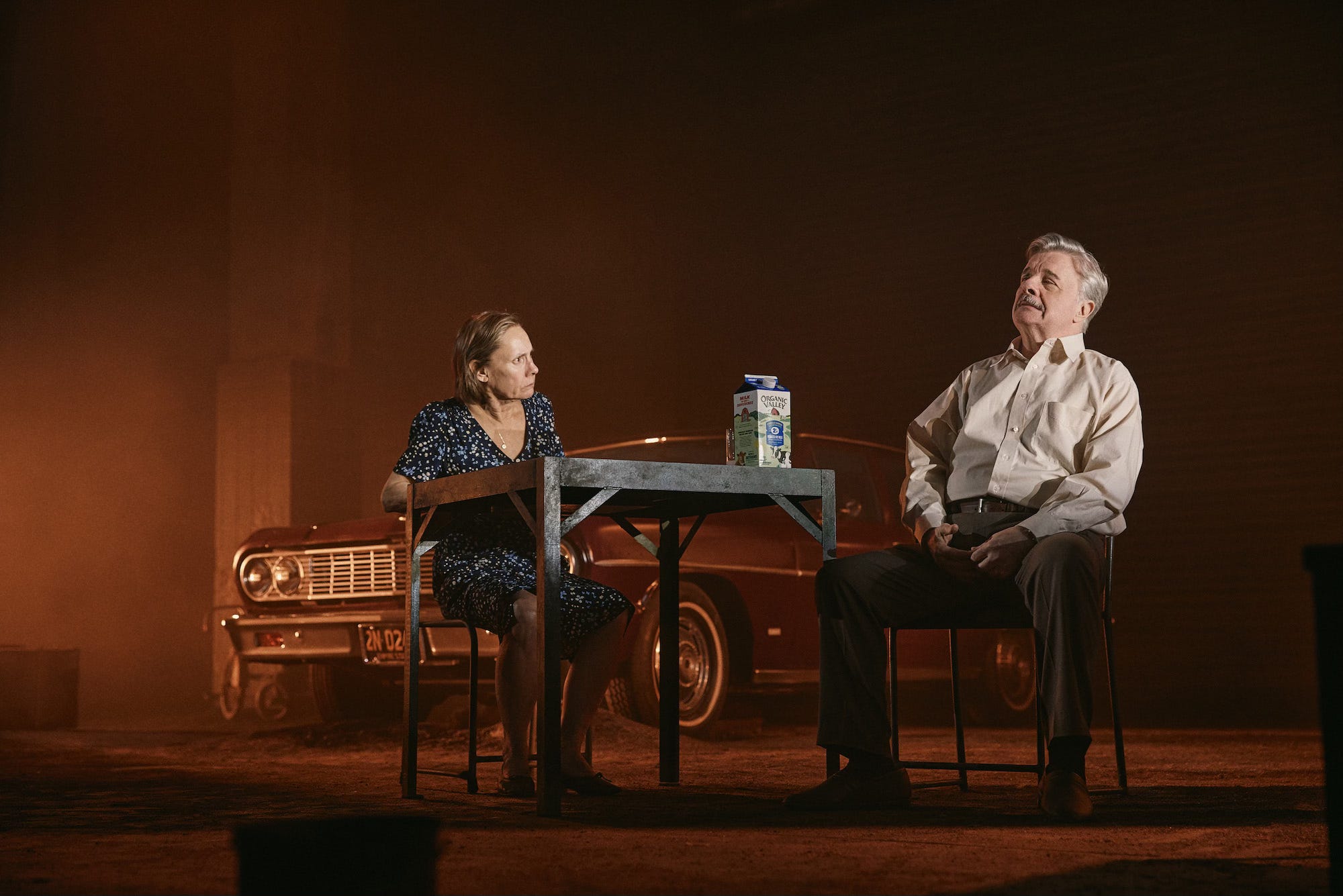
Did Lane mention the person responsible for putting Salesman together? He did not. Was he ungrateful? Rudin’s producing partner, billionaire master of all media Barry Diller, lamented, “I’m disappointed my colleagues did not thank him.”
Were they suffering a memory glitch, as Diller implied, or was another force at work? “They had Rudin’s blessing to omit his name, according to a person who worked closely with him,” the Times reported. (In an email, Rudin declined to comment.)
For more than two decades, Rudin’s shows had brought both serious drama and crowd-pleasing laughter to appreciative audiences, with new works including The Humans, Shuffle Along, and A Doll’s House, Part 2, and smashing revivals of Hello, Dolly! and A Funny Thing Happened on the Way to the Forum, among others.
But in 2021, around the time his starry revival of The Music Man set its sights on opening night, Rudin’s reputation was savaged by stories in The Hollywood Reporter and the Times exposing him as a ruthless taskmaster with a propensity for launching heavy objects against staff, and generally being miserable to whomever got in his way at a given moment. He reputedly smashed a computer on one assistant’s hand and ordered another to exit his car in the middle of a trip. Telephones and food had been flung; neither bodies nor walls were safe from his ire.
Miller’s play reveals Willy Loman in less than heroic terms. He games the system and models petty larceny to his adoring sons. He’s unfaithful to his long-suffering wife. He’s tired -- not only of being on the road, but of being on the losing end of a fickle system that prizes material wealth above all. Mostly, Willy keeps his demons, cancerous and, in the end, fatal, close to the vest. We pity Willy for failing to win a game whose terms are stacked against him, even as he desperately flouted them.
“There’s nothing in the American dream about character,” Nichols told me in a conversation after his Salesman had opened. “It’s a serious flaw. One of the sadder things in that particular version of the American dream is that it expects nothing from the individual except making it. And not getting caught.”
In 2014, Rudin had managed to survive one scandal when embarrassing emails were published during the infamous Sony communications breach. There were complaints about the modest investment returns of some of his hits, such as Dolly! When Rudin’s workplace not-so-secrets were exposed for all to see, the producer went into a self-imposed exile, intent on addressing his anger issues in therapy and by whatever means necessary.
Scott Rudin is no Willy Loman, to be sure. But Miller’s point is that the saccharine promises of the American Dream aren’t pure, and that reckoning will come eventually and take its toll.
At first Rudin made himself invisible. “All I ever wanted to do was produce plays,” he’d told the audience back in 2012. In truth, he never completely stopped.
A low profile after a scandal does not a recluse make. During the interregnum, Rudin and Diller continued developing programming for Diller’s pet project, a park and performance venue plunked in the Hudson River and dubbed Little Island, while mapping out his return to Broadway with shows to feature Metcalf, whom he called America’s actress non pareil.
“Laurie is the greatest actress in America,” Rudin told the Times, in a 2025 story that gifted him with a smooth and sympathetic re-entry into the Broadway bazaar. Refusing to endorse Rudin’s sudden status as persona non grata, Metcalf returned his compliment in The New Yorker, telling Michael Schulman, “I just think that, unless we think there is no possibility of real rehabilitation, then we shouldn’t ask people to try and do it.”
As further evidence of their work out of the spotlight, this past season, Rudin and Diller also produced the Off-Broadway premiere of Wally Shawn’s What We Did Before Our Moth Days. Ready for his public return, Rudin insisted that he is a new man, having taken steps to address his dark urges. “I learned I don’t matter that much, and I think that’s very healthy,” he averred. “I don’t want to let anybody down.”
Miller’s tragedy has been selling out the Winter Garden Theater, one of Broadway’s biggest venues (think Cats), and taking in $1.8 million a week at the box office. Want to see it Friday night? A pair of the best orchestra seats will run you $1,598.
Broadway, like Hollywood, loves a tale of redemption after a fall from grace. If there’s any doubt whether, notwithstanding boos from his detractors, Rudin still matters to Broadway a lot, there was also a gift included late in Sunday’s Tony show: A big musical number from The Book of Mormon, which has been showing signs of box office fatigue 15 years after its opening and is hungry for the kind of bump that an outing on international television can provide.
The original Mormon producer? Scott Rudin. Like him or not, Broadway needs Rudin, even if that means dodging brickbats from the unforgiving. For another thing Broadway shares with Hollywood is the truism that in the real American Dream, money talks and memories fade. It’s a fine romance.
Jeremy Gerard is consulting editor at Broadway Journal and author of The Man Who Saved Broadway, an upcoming biography of Bernard B. Jacobs. The opinions expressed are his own.
